
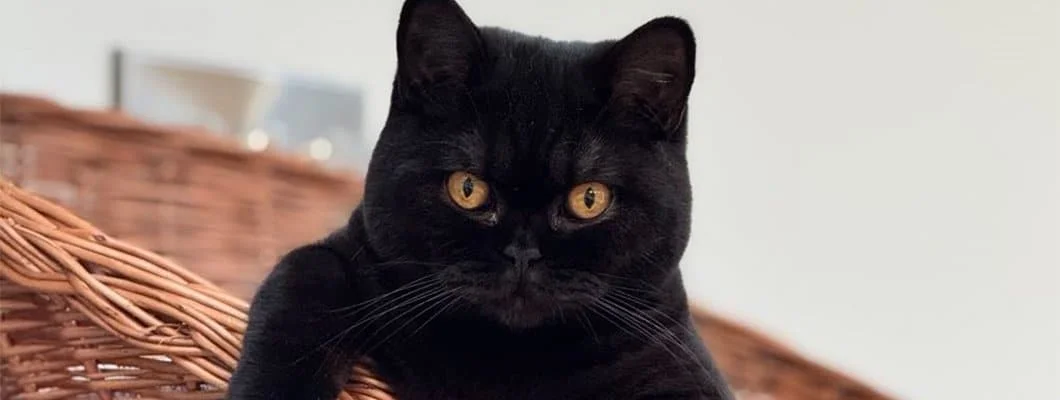
The black British Shorthair is one of the most striking colour varieties in the breed — and one that is often underestimated. Where the blue-grey variety softens the breed’s already rounded, solid features, the black variety sharpens them. A black British Shorthair in full show condition, with a dense jet coat, deep copper eyes, and that characteristic broad, round face, is a genuinely impressive cat.
Despite being one of the original and most established colours in the breed, black is sometimes overlooked by buyers drawn to the more unusual or fashionable colours. That is their loss. The black British Shorthair is a classic — and a very good one.
What Makes a British Shorthair Black?
The black coat is produced by two copies of the dominant black allele (BB or Bb) at the B gene locus, without the dilute gene. Black is the dominant colour in British Shorthairs — chocolate and cinnamon are both recessive to it, and dilution of black produces the blue-grey coat of the British Blue.
For the coat to appear truly black, the cat must also carry at least one copy of the non-agouti gene (aa), which suppresses the tabby pattern. Without this, the cat would express a black tabby pattern rather than a solid coat.
The GCCF breed standard for black British Shorthairs requires:
- A solid, dense, jet black coat from root to tip with no rusting, white hairs, or tabby ghost markings
- Deep orange or copper eye colour — large, round, and vivid against the black coat
- The same compact, broad-chested type and plush, crisp coat texture as any British Shorthair
Black British Shorthair Appearance
The black variety shares the British Shorthair’s compact, rounded, substantial build — but the coat colour gives the overall look a particular boldness that the softer colours do not have.
Coat: Solid, dense black from root to tip. No tabby markings, no white hairs, no brown tinge. The coat should have the dense, crisp, stand-off texture characteristic of the breed — not flat or silky. A well-maintained black coat has a genuine lustre and depth to it.
Eyes: Deep orange or copper. Large and round. The contrast between black coat and copper eyes is one of the most striking combinations in the pedigree cat world — and one that photographs exceptionally well.
Body: The same broad, muscular, compact build as any British Shorthair. Males typically weigh between 5 and 8 kg; females between 3.5 and 5.5 kg. The rounded head with full cheeks, strong chin, and small, well-set ears gives the black variety a particularly direct, commanding expression.
The Challenge of Maintaining a Black Coat
Black British Shorthairs can be more demanding to keep in show condition than some other colours, due to two specific issues.
Rusting: Exposure to direct sunlight causes the black pigment in the coat to oxidise, producing a brownish or reddish tinge — known as rusting. This is a fault in the show ring and looks poor generally. Keeping a black British Shorthair out of prolonged direct sunlight is the simplest preventive measure. A high-quality diet also helps maintain the depth and integrity of the coat pigmentation.
Ghost tabby markings: Young black British Shorthairs, and occasionally adults in changing coat condition, may show faint tabby markings — these are particularly visible in sunlight or at certain angles. In kittens this often fades completely as the adult coat comes in. In adults it can indicate either a cat still settling into its mature coat, a coat under nutritional stress, or a cat that simply carries more agouti expression than is ideal.
Neither of these issues affects the cat’s health — they are purely cosmetic and relevant mainly in a showing context. For a pet black British Shorthair, they are unlikely to concern you at all.
Black British Shorthair Temperament
Coat colour has no effect on temperament. A black British Shorthair has exactly the same character as any other colour variety: calm, steady, quietly affectionate, and adaptable.
British Shorthairs suit a wide range of households. They are reliable with children, tolerant of other cats and calm dogs, and adapt well to flat or indoor living. They are not demanding or highly vocal. They enjoy human company and will seek it out — but on their own terms and at their own pace.
The black variety has no special behavioural traits attributed to its colour — the idea that black cats have a different temperament is a persistent myth with no basis in feline genetics or behaviour. A black British Shorthair is a British Shorthair that happens to be black. The temperament is the same as any other.
For a full overview of what to expect living with a British Shorthair, see our British Shorthair personality guide.
Black British Shorthair Health
Health considerations for black British Shorthairs are the same as for the breed as a whole.
Hypertrophic cardiomyopathy (HCM): The most significant inherited condition in the breed. Annual cardiac echo screening should be standard for all breeding cats. Ask to see dated results for both parents — current, within the last 12 months.
Polycystic kidney disease (PKD): DNA test available, results should be clear for both parents.
Carrier status: Black British Shorthairs may carry one copy of the chocolate gene (making them black/chocolate carriers) or the cinnamon gene, without showing it in their coat. Responsible breeders DNA-test for this. It is not a health issue, but it affects what colours can appear in a litter — worth knowing if colour matters to you.
For a full breakdown of inherited health conditions in the breed, visit our British Shorthair health guide.
Are Black British Shorthair Cats Hard to Find?
Black British Shorthairs are less widely bred than blue, but more readily available than the recessive colours such as chocolate, cinnamon, or lilac. Most established British Shorthair breeders with a broad colour programme will produce black kittens at some point, and dedicated black breeders do exist.
Prices are typically in line with or slightly below blue from the same calibre of breeder — black has not acquired the fashionable premium of golden, and it is not as rare as the recessive colours. From a well-established, health-tested GCCF-registered breeder, expect to pay roughly £800–£1,400 for a black British Shorthair kitten.
To find GCCF-registered breeders, use our Find a Breeder directory.
Showing Black British Shorthairs
Black British Shorthairs have a long and successful showing history under the GCCF. The colour class is well-established, and a well-typed black with a sound coat and strong copper eyes competes very effectively.
In the show ring, judges look for soundness of colour first — any rusting, white hairs, or tabby markings are penalised. Beyond colour, the assessment is the same as for any British Shorthair: type, coat quality, eye colour, and overall condition. A black with excellent type and a slightly imperfect coat will beat a mediocre black with a perfect coat — type always takes precedence.
If you are interested in showing, the GCCF website provides a full schedule of licensed shows and the breed standard that defines what judges are looking for.
Black British Shorthair FAQs
Are black British Shorthairs unlucky?
No — that is a cultural superstition with no basis in fact. In the UK, black cats are traditionally considered lucky, which is the more common association. In any case, the character of a cat has nothing to do with its coat colour.
Do black British Shorthair kittens change colour as they grow?
The coat remains black throughout, though ghost tabby markings common in kittens usually fade as the adult coat develops. Rusting (a brownish tinge) can develop in adults kept in direct sunlight or fed a poor diet, but this is preventable.
Are black and blue British Shorthairs related genetically?
Yes — blue is the dilute version of black. A black British Shorthair carrying two copies of the dilute gene would be blue. Many British Shorthair breeders work with both colours, and black cats in a breeding programme may carry the dilute gene without expressing it.
How do I keep a black British Shorthair’s coat looking its best?
Limit prolonged exposure to direct sunlight, feed a high-quality diet with good protein content, and groom regularly with a rubber grooming mitt to remove loose hair and keep the coat looking its densest. A well-fed, well-cared-for black British Shorthair has a genuinely impressive, lustrous coat.
Can a black British Shorthair have green eyes?
The breed standard for solid black British Shorthairs requires deep orange or copper eyes. Green eyes are not standard in solid black — a black British Shorthair with green eyes may carry the inhibitor gene associated with silver or golden varieties, suggesting a more complex genetic background. Eye colour outside the standard is a fault in the show ring but has no effect on the cat as a pet.
Is a Black British Shorthair Right for You?
If you want a bold, striking, classic-looking cat with an excellent temperament and minimal fuss, the black British Shorthair is an outstanding choice. It is not a fashionable colour in the way that golden has become, and it does not carry the rarity premium of chocolate or lilac — which means you are choosing it because you genuinely love the look, and paying a fair price for it.
A well-bred black British Shorthair from a health-tested, GCCF-registered breeder is a cat that will look extraordinary in good condition and live contentedly alongside you for fifteen years or more.
Explore the full range of British Shorthair colours, or find a registered breeder through our Find a Breeder directory.