
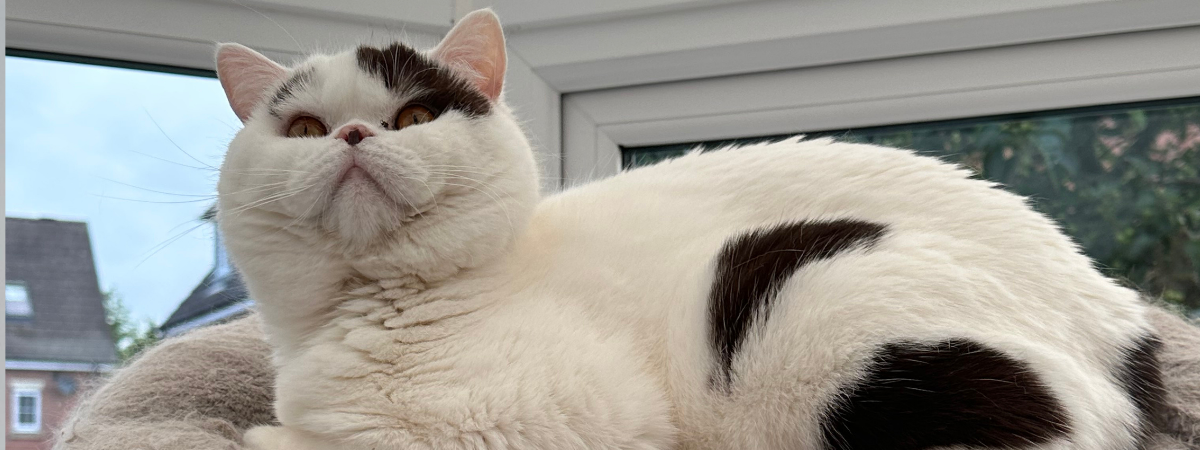
The bi-colour British Shorthair combines the breed’s solid colours with white, producing a cat with clearly defined areas of colour against a crisp white background. From a small white locket on the chest of an otherwise solid cat, through to the bold Van pattern where white covers most of the body and colour appears only on the head and tail, the bi-colour varieties bring a graphic quality to the British Shorthair’s already striking appearance.
Bi-colour is not a single variety — it is a family of patterns defined by the amount of white present. Understanding the different types, what the GCCF standard requires for each, and the genuine challenge of breeding well-marked bi-colour cats helps buyers know what to look for and what questions to ask.
What Makes a British Shorthair Bi-colour?
The white in a bi-colour British Shorthair is produced by the white spotting gene (S) — sometimes called the piebald gene. This is an entirely different gene from the dominant white gene (W) that produces the solid white British Shorthair. The white spotting gene adds white to an otherwise coloured coat in variable amounts, with the degree of white roughly (though not precisely) proportional to how many copies of the gene the cat carries.
The white spotting gene behaves variably — even two cats with the same number of gene copies can express quite different amounts of white. This unpredictability is one of the central challenges of breeding show-quality bi-colour cats. Achieving a symmetrical, well-defined pattern with the right amount of white in the right places is one of the most technically demanding aspects of British Shorthair breeding.
The colour in a bi-colour can be any of the solid British Shorthair colours — blue, black, white, chocolate, lilac, cinnamon, red, cream, golden, silver, or tabby pattern. The most commonly seen are blue-and-white (the blue bi-colour) and black-and-white, but bi-colour is recognised across the full range of solid colours.
Types of British Shorthair Bi-colour Pattern
The GCCF and international cat fancy broadly recognise three levels of white in bi-colour cats:
Bi-colour: The standard bi-colour has a roughly even split between colour and white — typically somewhere between one third and two thirds of the coat is white. Colour appears as clearly defined patches against the white, ideally with some symmetry. The inverted V of white on the face (sometimes called a blaze) is a particularly valued marking in show bi-colours.
Harlequin: A higher degree of white — most of the cat is white, with colour restricted to the head and several distinct patches on the body and tail. The effect is bold and graphic, somewhat like a patchwork.
Van: The highest expression of white — named after the Turkish Van breed which fixed this pattern. The body is almost entirely white, with colour restricted to the top of the head (typically between and around the ears) and the tail. A well-marked Van British Shorthair is a striking, unusual-looking cat.
In practice, producing a cat at exactly the right point of the pattern spectrum — and with the symmetry and clarity the show standard demands — is genuinely difficult. Many bi-colour British Shorthairs fall somewhere between these categories, and litters from bi-colour breeding programmes produce a range of white distribution rather than a predictable, consistent pattern.
What the GCCF Standard Requires for Bi-colour
The GCCF breed standard for bi-colour British Shorthairs calls for:
- Clearly defined patches of colour and white — the colour and white areas should not intermingle or bleed into each other
- Symmetry — while perfect symmetry is extremely difficult to achieve, better symmetry between the left and right sides is consistently preferred
- Sound colour — the coloured patches should be as good a quality as they would be in a solid cat of that colour
- Correct type — the same broad, rounded head, compact body, and dense plush coat as any British Shorthair
In the show ring, a common observation is that breeders who produce excellent type in solid colours sometimes struggle to maintain that type while also achieving good bi-colour markings — and vice versa. The best bi-colour breeders manage both, which is part of why genuinely excellent show-quality bi-colour British Shorthairs are so valued.
Blue-and-White: The Most Common Bi-colour Variety
The blue-and-white bi-colour is the most widely bred and most frequently seen bi-colour variety in the UK. The combination of the British Blue’s distinctive blue-grey coat with bright white patches is immediately striking, and the contrast between the cool blue and the crisp white is particularly effective on the British Shorthair’s rounded, substantial type.
Blue bi-colours appear regularly in show classes and from established breeders. If you are specifically looking for a bi-colour British Shorthair and have no strong preference on colour, the blue-and-white is the most readily available and has the broadest base of reputable breeders to approach.
Bi-colour vs Tortoiseshell-and-White
A question that sometimes causes confusion: what is the difference between a bi-colour and a tortoiseshell-and-white?
- Bi-colour: Combines one solid colour (or tabby pattern) with white. Two elements — one colour and white.
- Tortoiseshell-and-white (torbie or tortie-and-white): Combines the tortoiseshell pattern (two colours — black/blue and red/cream) with white. Three elements — two colours and white.
Tortoiseshell-and-whites are sometimes called calico in North American terminology. In the GCCF they are typically registered as tortoiseshell-and-white or blue-cream-and-white depending on the specific colour combination. They are a separate variety from bi-colour, with their own show classes.
Bi-colour British Shorthair Temperament
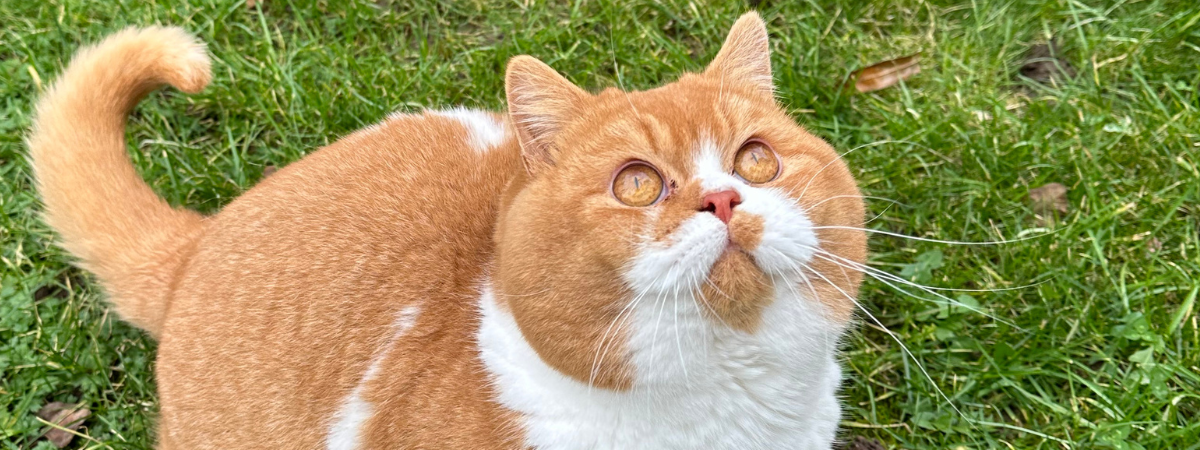
Coat pattern does not affect temperament. The bi-colour British Shorthair has exactly the same calm, adaptable, affectionate character as any other colour or pattern variety.
British Shorthairs are steady, quiet, and easy to live with. They suit families, single owners, flat and house living, and mixed-pet households. They are not demanding or highly vocal, and they handle time alone reasonably well. All of these characteristics hold true across every colour and pattern variety, including bi-colour.
For a full overview of what to expect from the breed in terms of character and daily life, see our British Shorthair personality guide.
Bi-colour British Shorthair Health
Health considerations are the same as for the breed generally. The white spotting gene in bi-colour cats is distinct from the dominant white gene (W) associated with deafness in solid white cats — bi-colour British Shorthairs do not carry the same deafness risk.
Hypertrophic cardiomyopathy (HCM): Annual cardiac echo screening of all breeding cats should be standard. Ask for current, dated results for both parents.
Polycystic kidney disease (PKD): DNA test available; results should be clear for both parents.
White areas and sun sensitivity: The white-patched areas of a bi-colour cat have reduced pigmentation in that skin — as with any white-coated cat, white patches can be more susceptible to sunburn and UV damage, particularly on exposed areas like the ears. This is a minor practical consideration for cats with outdoor access in summer.
For a full overview of inherited conditions in the breed, see our British Shorthair health guide.
Buying a Bi-colour British Shorthair in the UK
Bi-colour British Shorthairs — particularly blue-and-white — are produced by a good number of established UK breeders. The variety is well-represented in show classes and has a broad base of dedicated breeders. Other colour combinations (black-and-white, chocolate-and-white, and the rarer recessive colour bi-colours) may require a more targeted search.
What to look for:
- GCCF registration papers — colour and pattern listed correctly
- HCM cardiac echo results for both parents — current and dated
- PKD DNA test results — clear for both parents
- Photographs of adults from the breeder’s programme — bi-colour patching is variable and heritable in tendency; seeing adults from the same lines gives a realistic picture of likely pattern quality
- A breeder who can discuss how they approach bi-colour breeding and what patterns they typically produce
A note on pattern variability: Because the white spotting gene expresses variably, litters from bi-colour breeding programmes produce a range of white distribution — some kittens may be very lightly marked, others more heavily so. If the specific pattern type matters to you (bi-colour vs harlequin vs Van), discuss this with the breeder before committing.
Price: Bi-colour British Shorthair kittens from reputable, health-tested, GCCF-registered breeders typically range from £900 to £1,500. Show-quality bi-colours with excellent type and well-marked patterns may attract higher prices.
To find GCCF-registered British Shorthair breeders in the UK, use our Find a Breeder directory.
Bi-colour British Shorthair FAQs
Is the white in a bi-colour British Shorthair the same as in a solid white British Shorthair?
No — they are produced by different genes. Solid white British Shorthairs carry the dominant white gene (W), which masks the entire coat. Bi-colour British Shorthairs carry the white spotting gene (S), which adds white patches to a coloured coat. The two genes are unrelated, and the deafness risk associated with the dominant white gene does not apply to bi-colour cats.
Can you predict how much white a bi-colour kitten will have as an adult?
Approximately, but not precisely. The white spotting gene expresses variably, and even kittens from the same litter can have quite different amounts of white. The pattern is also relatively unstable in early kittenhood — white areas can look slightly different in a young kitten versus the adult coat. Experienced breeders can give a reasonable estimate, but the specific adult pattern is not perfectly predictable.
What is a Van British Shorthair?
A Van British Shorthair has the highest level of white — essentially an all-white cat with colour restricted to the top of the head and the tail. It is the most extreme expression of the white spotting gene. Well-marked Van British Shorthairs are unusual and striking. Do not confuse a Van British Shorthair with a Turkish Van — they are entirely separate breeds.
Are bi-colour British Shorthairs harder to breed than solid-coloured cats?
Yes — achieving the pattern quality and symmetry required for show standard is one of the more technically demanding aspects of British Shorthair breeding. Breeders who produce consistently good bi-colour type and pattern have usually spent years developing their lines.
Do bi-colour British Shorthairs have any specific health needs?
No more than any British Shorthair. The minor consideration around UV sensitivity on white-patched skin (particularly ears) is easy to manage by limiting extended sun exposure. Beyond that, health considerations are the same as for any British Shorthair of the relevant base colour.
Is a Bi-colour British Shorthair Right for You?
If you want the bold, graphic quality that the white-and-colour combination brings to the British Shorthair’s already striking rounded type — and you are comfortable with the variability in pattern that comes with the territory — the bi-colour varieties are a wonderful choice.
The blue-and-white bi-colour in particular is one of the most eye-catching and widely available colour combinations in the breed. A well-marked bi-colour British Shorthair in good condition, with clear, symmetrical patching and sound colour, is a genuinely impressive cat.
Explore the full range of British Shorthair colours and patterns, or find a registered breeder through our Find a Breeder directory.