
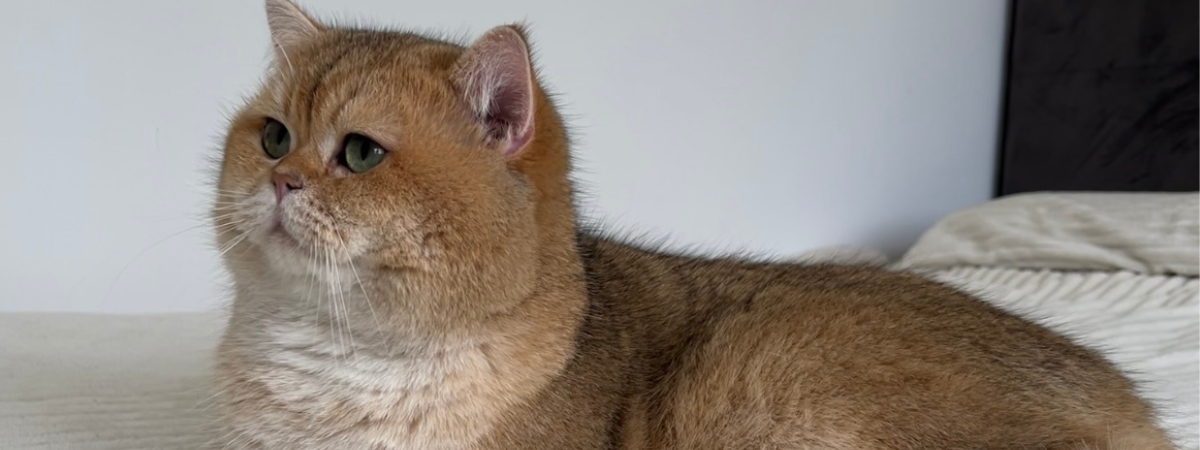
The golden British Shorthair is one of the most visually striking cats in any breed. That warm, shimmering coat — apricot to rich gold with dark tipping and bright green eyes — is unlike anything else in the pedigree cat world, and it has made the golden variety one of the most sought-after British Shorthairs in the UK over the past decade.
If you are considering a golden British Shorthair, this guide covers everything you need to know: what produces the colour, how it develops, what to look for in a well-bred kitten, and what to watch out for when searching for a reputable breeder.
What Makes a British Shorthair Golden?
The golden coat is produced by the inhibitor gene (I), which in silver British Shorthairs suppresses yellow pigment to create a white or pale undercoat. In golden cats, this suppression is incomplete — the result is a warm, yellow-to-apricot undercoat rather than a white one, combined with dark tipping on each individual hair.
The contrast between the warm undercoat and the darker tips creates the characteristic shimmering, glowing effect that makes goldens so distinctive. When the cat moves, the coat catches the light differently depending on how the hair lies — this is one of the most photographed British Shorthair varieties for good reason.
Eye colour in goldens should be deep green or blue-green — a requirement that sets them apart from most other British Shorthair colours, which have orange or copper eyes. The combination of a rich golden coat and vivid green eyes is genuinely striking and is one of the key selling points of the variety.
Types of Golden British Shorthair
The term “golden British Shorthair” covers a range of tipping intensities, from the very lightly tipped to the heavily tipped. The three main types are:
Tipped golden (chinchilla golden): The lightest expression, where only the very tips of the hairs carry the dark pigment. The overall impression is a very pale, glowing golden coat with a sparkle to it. This is sometimes called the chinchilla golden.
Shaded golden: A heavier degree of tipping — roughly the top third to half of each hair is tipped. The coat is richer and darker than a tipped golden, with a deeper gold tone. This is the most commonly seen type in the UK.
Golden smoke: The most heavily tipped variety, where the dark pigment covers most of the hair length and the coat appears almost solid at first glance. The warm golden undercoat is only revealed when the coat is parted.
The degree of tipping is a genetic trait, not just an age-related change — though all goldens can look quite different as kittens compared to their adult coat, which I cover below.
How the Golden Coat Develops
One of the most common questions from buyers is why their golden British Shorthair kitten looks so different from the adult cat they expected.
Golden kittens typically look quite dark at birth, often appearing almost grey or dusky. The true golden undercoat develops progressively over the first one to two years, and many cats do not reach their full adult colour until 18 months to two years old. Young goldens can also show fairly obvious tabby ghost markings that fade as the adult coat comes in — this is entirely normal and not a fault.
If you are buying a golden kitten specifically for colour, it is worth asking the breeder to show you photographs of their adults at maturity, and asking which type — tipped, shaded, or smoke — their breeding programme produces.
Golden British Shorthair Temperament
The golden British Shorthair has exactly the same temperament as any other British Shorthair. Coat colour does not affect character — this is a consistent, gentle, and adaptable breed regardless of colour variety.
British Shorthairs are calm, quietly affectionate, and independent. They enjoy human company but do not demand attention. They settle well into family households and adapt easily to indoor life. They are not a highly vocal or energetic breed — the golden’s glamorous appearance is paired with an entirely unfussy, easy-going personality.
For a full overview of what to expect from the breed in terms of character and suitability, see our British Shorthair personality guide.
Golden British Shorthair Health
Health considerations for golden British Shorthairs are the same as for the breed as a whole. All responsible breeders should cardiac-screen their cats annually for hypertrophic cardiomyopathy (HCM) and DNA-test for polycystic kidney disease (PKD). Always ask to see current results for both parents before committing to a kitten.
One additional point worth noting for goldens specifically: because the golden coat is associated with the inhibitor gene, some goldens can carry and express the silver gene, producing kittens that bridge the two types. This is not a health issue — it is purely a breeding consideration — but it is worth discussing with your breeder if colour accuracy matters to you.
For a full breakdown of inherited conditions to be aware of in the breed, see our British Shorthair health guide.
Buying a Golden British Shorthair in the UK
The golden British Shorthair has grown significantly in popularity over the past decade. Demand consistently exceeds supply, and prices are higher than for many other British Shorthair colours. Expect to pay between £1,000 and £2,000 for a well-bred golden kitten from a reputable, health-tested breeder — prices at the upper end and beyond are not unusual for show-quality or particularly richly-coloured kittens.
Because goldens attract a premium, they also attract less scrupulous sellers. Here is what to look for and what to avoid:
Signs of a reputable breeder:
- GCCF registration papers as standard
- HCM cardiac echo results for both parents — current, dated within the last 12 months
- PKD DNA test results for both parents — clear
- Kittens raised underfoot in a home environment
- A waiting list — good golden breeders rarely have immediate availability
- Happy to answer questions about their lines, their colour programme, and the development timeline for their kittens
Red flags:
- Multiple litters always available — volume breeding
- No health test paperwork offered or shown
- Significantly lower price than the market average with no explanation
- Kittens described as “golden” that are actually silver or shaded silver — the two colours can look similar in photographs, particularly in kittens
To find GCCF-registered British Shorthair breeders with golden cats, visit our Find a Breeder directory.
Golden British Shorthair FAQs
Are golden British Shorthairs rare?
They are not as rare as the recessive colours such as cinnamon or fawn, but they are less commonly bred than blue or black. Good golden breeders typically have waiting lists, and demand outstrips supply in most years.
What eye colour should a golden British Shorthair have?
Deep green or blue-green. This is a breed standard requirement, not just a preference. Orange or copper eyes in a cat sold as golden should prompt questions — it may be a golden-toned tabby rather than a true golden.
Do golden British Shorthairs change colour as they grow?
Yes, significantly. Golden kittens look much darker than adults, often appearing dusky or even greyish at birth. The full adult colour develops gradually, with most cats reaching their final coat around 18 months to two years.
Is a golden British Shorthair the same as a chinchilla British Shorthair?
The term chinchilla golden is sometimes used for the most lightly tipped golden variety. Chinchilla more commonly refers to Persians, but in British Shorthairs it describes the very lightest degree of tipping. A shaded golden has heavier tipping and a richer, deeper coat.
Are golden British Shorthairs good pets?
Excellent ones. The temperament is the same as any British Shorthair — calm, adaptable, quietly affectionate, and easy to live with. The striking appearance is a bonus on top of an already excellent character.
Is a Golden British Shorthair Right for You?
If you want one of the most visually distinctive cats in the pedigree world combined with a calm, adaptable British Shorthair temperament, the golden variety delivers both. Be prepared for a waiting list, a higher price than many other colours, and a kitten that will look quite different at 12 weeks than it will at two years old.
Choose a breeder who health-tests, GCCF-registers, and raises their kittens in a home environment — and be patient. A well-bred golden British Shorthair is worth waiting for.
Explore the full range of British Shorthair colours to compare the golden with other varieties, or find a registered breeder through our Find a Breeder directory.